.png)
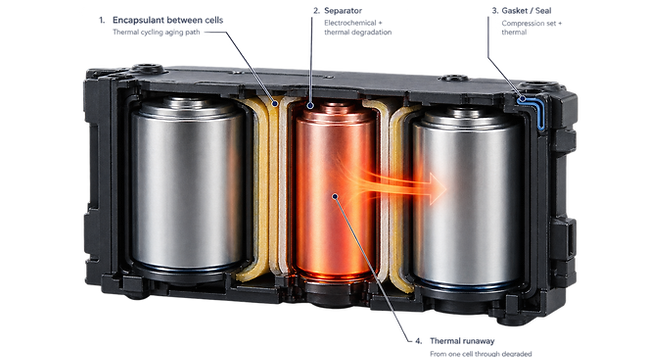
Unified, physics-based prediction for rubber aging and failure across thermal oxidation (DLO), fatigue, compression set, hydrolysis, and ozone attack.
K-Load models active damage modes, K-Fail predicts remaining life, and K-Extreme assesses post-event survivability. 95% accuracy in CNPC HPHT trials, validated across NR, NBR, and Silicone/SBR.

Trusted by Industry, Government & Research Leaders


What Is Rubber Aging?
Rubber aging is the irreversible change in mechanical and chemical properties caused by heat, oxygen, UV, ozone, fatigue, and environmental exposure. Rates depend on material chemistry (NR, NBR, EPDM, SBR, FEPM, silicone), geometry, and service conditions.
ASTM D573 and ISO 188 provide aging data points, not a complete model. ElastoSure couples temperature, time, geometry, load, and environment to predict degradation under real service conditions.
Below ~80°C, oxidation is relatively uniform. Above ~100°C, oxygen diffusion becomes limiting, creating Diffusion-Limited Oxidation (DLO). Arrhenius extrapolation from thin samples can miss DLO in thick parts.
What You Get From ElastoSure
Output
Property retention curve
What It Tells You
How tensile strength, elongation, hardness, and compression set change over time under real service conditions
Decision Enabled
Predict when the rubber crosses the end-of-life threshold -- before it does in the field
DLO oxidation gradient
How deep oxidation has penetrated through the rubber cross-section at any time
Explain why thick seals fail faster than thin test samples at the same temperature
Fatigue life (N cycles)
Number of cycles to crack initiation and propagation to failure under specified load
Qualify rubber components for cyclic load applications without full fatigue test program
Remaining Useful Life (RUL)
Time remaining before the rubber falls below the minimum specification
Schedule replacement before failure -- not after it
Shelf life (years)
Time rubber can be stored without exceeding end-of-life threshold
Set stock rotation schedules and warranty periods on data, not arbitrary standards
Survivability Index (post-event)
Probability component is still within spec after HPHT / fire / blast exposure
Data-driven return-to-service or replacement decision after extreme events
Who Uses This

Oil & Gas
HPHT packer seals, wellbore liners & downhole FKM/NBR components — CNPC validated
Explore Oil & Ga
→

Aerospace & Defense
Rubber gaskets, O-rings & blast-protective elastomers — seal assessment
Explore Aerospace & Defense
→

Automotive
Rubber mounts, hoses & door seals — fatigue and compression set life
Explore Automotiv
→
ElastoSure in Action
Case Study

CFRP Moisture Aging
Moisture absorption and Tg degradation prediction with coupon test validation.
View Case Study →

Wind Turbine Blade Aging
20-year prediction of fatigue damage and UV surface oxidation.
View Case Study →