.png)

Cable Insulation Aging Prediction Software - KSENSE
Cable failures in nuclear and industrial systems are rarely sudden—they are the result of years of thermal, radiation, and chemical degradation in insulation materials. Yet most operators still rely on periodic inspection or conservative replacement schedules.
K-Sense is cable insulation aging prediction software that uses your existing FDR and NDE data to predict remaining useful life (RUL) in real time—without waiting for failures or multi-year testing.
Turn your existing diagnostic data into actionable lifetime predictions.
Elastomers, Thermoplastics and compositesDon’t guess material health. Quantify it through images.
Cable Insulation Aging Prediction Software
Use Existing FDR Cable Diagnostic Digital Twin
K-Sense integrates directly with:
-
Frequency Domain Reflectometry (FDR)
-
NDE inspection data
-
Imaging and sensor-based diagnostics
Instead of raw signal interpretation, K-Sense converts this data into:
-
Remaining Useful Life (RUL)
-
Degradation rate
-
Failure probability
Nuclear Cable Condition Monitoring (Continuous Insight)
-
Track insulation degradation under:
-
Radiation exposure
-
Thermal aging
-
Oxidation and crosslinking
-
-
Replace periodic inspection with continuous predictive monitoring
NDE Polymer Remaining Life Prediction
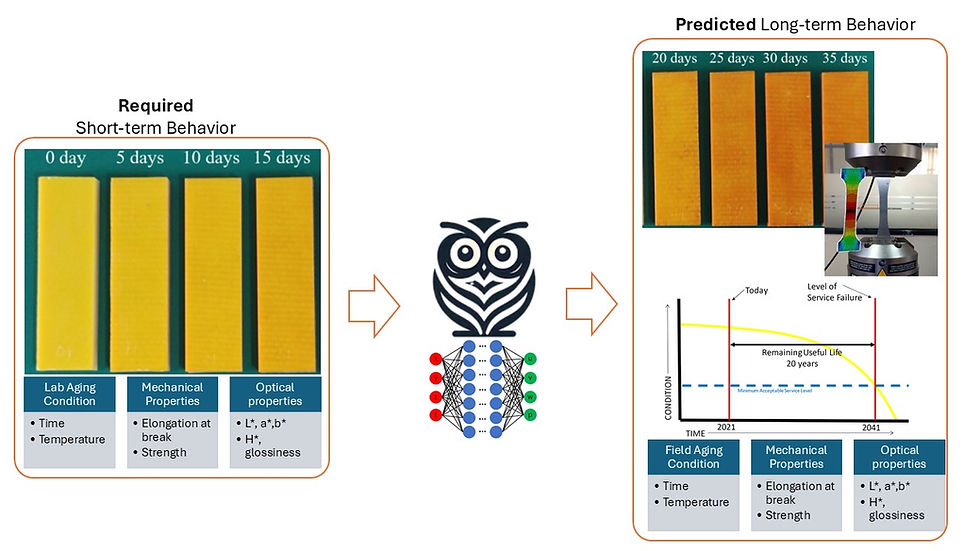
K-Sense uses physics-informed AI to connect observable signals (color, dielectric response, imaging) to:
-
Mechanical properties (elongation, tensile strength)
-
Chemical degradation kinetics
-
Long-term performance
Failure Properties
Color Change
Remaining Useful Life
ElastoSure Products Powering K-SENSE
FORMULATION OPTIMIZATION
polymer formulation optimization software
• Test 10× fewer compounds
• Compress 18-month cycles to days
• Accelerated aging test replacement

Accelerating the Digital Transformation of Industry with Simulation
Every industy faces unique, constantly evolving challenges. ElastoSure delivers the expertise, capabilities and tools to transform the design and production processes of industries.

Oil & Gas
Model seal and elastomer degradation under heat, pressure, H2S, chemicals, and long-duration downhole exposure.

Defense & Aerospace
Support mission-life prediction for polymer components under extreme environments, storage, radiation, thermal cycling, and mechanical fatigue.

Rubber & Elastomers
Predict when seals, O-rings, gaskets, and elastomer components approach leakage, stiffness loss, cracking, or compression-set thresholds.
K-Sense: Optical Diagnostics for Polymer Aging
Outputs:
Imaging for Condition Monitoring
The Problem: Traditional reliability models require multi-year physical tests to certify a single compound which can be elastomers, epoxies, thermoplastics, and thermosets.
K-Sense Physics-based AI architectures understand the underlying chemistry of oxidation and cross-linking.
-
60% Reduction in Testing Duration
-
Physics-Driven Extrapolation
-
High Confidence Ratio by Tracing Compound Specific Kinetics
K-Sense Superiority to Statistical Models
We validate our digital twins using a rigorous two-step protocol that ensures your field data matches our lab-trained models.
Step 1: Limited Training Set required
We ingest data from coupon-level accelerated tests (Thermal, Radiation, or Synergistic). This "seeds" the PINN with the material’s specific degradation kinetics.
Step 2: High Accuracy in Long-Term Predictions
We compare K-Sense predictions against independent "Long-Tests"—real-time service data or extended duration lab tests. The Result: Our models consistently show high agreement with long-term mechanical decay (Elongation at Break, Tensile Strength, and Modulus) that legacy Arrhenius models simply cannot capture.


K-SENSE
Machine-learned survivability estimation.
Summary: K-Extreme is a machine-learned engine that provides conservative estimates of survivability by calculating the minimum damage capacity needed to survive single-event effects (SEE) such as: loss-of-coolant accidents in nuclear reactors, solar flares for space applications and nuclear detonation simulations for strategic defense applications. K-Extreme then takes into account the available data on different SEE and uses them to predict survivability in case of a new SEE.


