.png)
Electronic packaging polymers protect critical components but can degrade through thermal fatigue, moisture, UV exposure, and creep. ElastoSure K-Load predicts these combined aging mechanisms, while K-Flash models curing, exotherm risk, residual stress, and final degree of cure.

Trusted by Industry, Government & Research Leaders


What Is Electronic Packaging Material Reliability?
Electronic packaging polymers face thermal cycling from -55 to +125°C, creating cyclic stress from CTE mismatch between polymer, silicon, metal, and ceramic materials. Repeated cycles accumulate fatigue damage at interfaces and within the polymer matrix.
JEDEC reliability tests assess moisture sensitivity, thermal cycling, and accelerated humidity through pass/fail results. They do not predict remaining cycle margin, changing failure modes, or differences between test and field conditions.
Humidity causes swelling and hydrolysis, creating dimensional mismatch while reducing polymer strength and modulus. In molding compounds, absorbed moisture can vaporize during reflow, causing popcorn cracking through internal pressure.
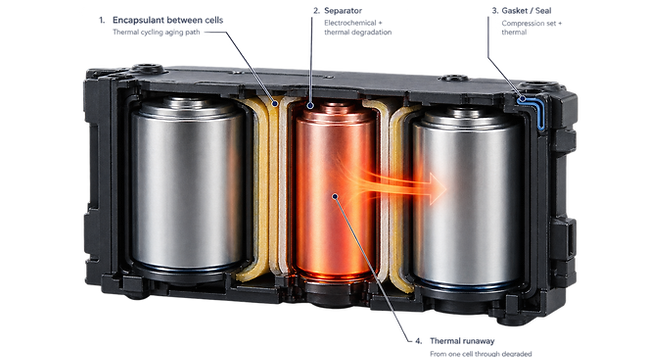
What You Get From ElastoSure
Output
Thermal fatigue Damage Index
What It Tells You
Cumulative CTE mismatch fatigue damage per thermal cycle, by package zone
Decision Enabled
Identify failure-prone interfaces before reliability test; optimize package geometry to extend life
Cycles to underfill cracking
Predicted cycle count to crack initiation in underfill or molding compound
Replace pass/fail reliability test with a quantified cycle margin for design decisions
Moisture absorption profile
Water content distribution through encapsulant vs. time and humidity level
Predict popcorn cracking risk from moisture content at reflow temperature; set bake-out schedule
Cure exotherm map (K-Flash)
Temperature distribution inside thick encapsulant during cure, including runaway risk zones
Optimize cure schedule before first pour; eliminate wasted material from runaway scrap
Who Uses This

Aerospace & Defense
MIL-STD-883 thermal cycling, avionics encapsulant aging, and combined radiation + thermal aging.
Explore Aerospace & Defense
→

EV & Automotive
AEC-Q200 electronics, underfill fatigue, and power module encapsulant aging at 150°C+.
Explore EV & Automotive
→

Medical Electronics
Implantable encapsulant aging in body fluids and sterilization effects on conformal coatings.
Explore Medical Electronics
→
ElastoSure in Action
Case Study

Flip-Chip Underfill Fatigue
CTE mismatch fatigue analysis through 10,000 thermal cycles
View Case Study →

Encapsulant Cure Exotherm
Cure temperature distribution in a thick potting compound
View Case Study →