top of page

Defense Material Survivability & Reliability Simulation

Military-Grade Validation

Defense Program Tested

Karax K-Suite

🛡️ Validated on Defense Programs

✅ MIL-STD-810 / MIL-SPEC Compatible

⏱ Remaining Useful Life Prediction Without Physical Teardown

The Defense Material Readiness Problem

Defense platforms operate in environments that destroy civilian testing assumptions — and they do it for 20, 30, sometimes 40 years.


A Parker CPI hydraulic seal in a rotorcraft transmission has been cycling through -40°C Arctic deployments and +65°C desert ground operations. A DSM Dyneema UHMWPE ballistic panel was qualified for impact resistance but has accumulated three years of UV exposure and humidity in a forward operating base. A DuPont Kevlar 49 composite component on a vehicle hull has absorbed blast overpressure from nearby detonations — load events that aren't in any qualification test protocol.


Standard MIL-SPEC qualification tests are point-in-time measurements. They tell you what a material can do when it's new. They don't tell you what it can do after a decade of compound field history.


The consequence: defense programs either over-replace components on conservative calendar schedules — burning budget on parts that have years of life remaining — or they wait until materials fail in service, which is worse. K-Suite eliminates both options by answering the question qualification tests can't: what is the condition of this material right now, and how much life is left?

How K-Suite Solves Defense Material Reliability

The comprehensive module. Defense materials degrade from five simultaneous mechanisms: thermal, mechanical fatigue, chemical, radiation (for nuclear-adjacent or EMP environments), and UV. K-Load models all five simultaneously — not sequentially — and compounds them through service time. This is the correct model for real operational history.

Model resistance to PFAS-containing MIL-PRF-5606 hydraulic fluid, CBRN decontamination chemicals, JP-8 fuel, and MIL-L-23699 oil on elastomeric systems. Predicts swelling, extraction, and hardness change over sustained field exposure.

Blast, Impact & Thermal Survivability

Models property retention in DuPont Kevlar 49, DSM Dyneema SK75, and SpectraShield composite panels following extreme single-event exposure (blast overpressure, heat spike, ballistic impact) combined with long-duration thermal and UV history. Predict residual tensile strength and delamination resistance after a specific event.


Seals in jet engine bays, exhaust system gaskets, and high-temperature structural adhesives (Henkel EA 9394, 3M AF163-2) age under combined thermal oxidation and operational cycling. K-Load predicts when these components will reach the property threshold that triggers replacement.

Elastomeric isolators, dampers, and seals in tracked vehicles, UH-60 helicopters, and shipboard systems fatigue under sustained platform vibration. K-Load models shear modulus loss and crack initiation in Parker CPI compound seals, Trelleborg vibration isolation mounts, and Lord Corporation elastomeric dampers under combined thermal and vibrational duty cycles.

Validation — Defense Program Tested

K-Suite simulation frameworks have been validated on aerospace and defense-adjacent programs. Validation data on specific defense programs is under review per data agreements and will be published upon clearance. Published cross-industry validation confirms 95% improvement in 5-year property prediction accuracy over Arrhenius single-stressor extrapolation — the baseline most MIL-SPEC qualification protocols still use.


K-Suite is available for a data-matched validation exercise against your program's historical material test data before commitment. Contact us to initiate.

Defense Applications
195749_e88ff391d564409f9de37f54d91f33dc~mv2.avif

Rotary Wing Hydraulic Seals

Life prediction for Parker FKM compound O-rings and quad-rings in rotor head and transmission systems aging under combined temperature cycling, MIL-PRF-5606 fluid exposure, and vibration.​

HPHT elastomer and seal aging simulation

Electronic Warfare Equipment

Henkel Ablestik potting, Dow Corning silicone conformal coating, and cable harness insulation in deployed EW systems age under combined thermal cycling and vibration. Predict when dielectric properties fall below spec.

Aerospace polymer aging and durability simulation

Armored Vehicle Systems

Fuel system elastomers, track pad rubber compounds, and vehicle hull sealants aging under combined heat, UV, and mechanical load. Replace calendar-based replacement with condition-based intervals.

HPHT elastomer and seal aging simulation

CBRN Protective Materials

MOPP gear polymers, chemical agent resistant coatings (CARC), and NBC filter media age under UV and chemical exposure cycling. K-Load predicts barrier property retention over storage and deployment life.

Defense material survivability and reliability simulation

Body Armor & Protective Composites

UHMWPE (DSM Dyneema, Honeywell Spectra) and aramid (DuPont Kevlar) panels aging under UV, moisture, and thermal cycling. K-Load predicts interlaminar delamination probability and ballistic resistance retention.

Nuclear cable aging and condition monitoring

Weapon System Elastomers

Breech seals, firing mechanism O-rings, and propellant-exposed compounds require life prediction under intermittent extreme stress. K-Suite models degradation accumulation between operational events.​

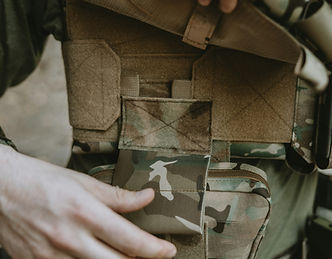
Armed Soldiers Outdoors

What You Get

Platform-specific RUL (Remaining Useful Life) — quantified life remaining in fielded components at the current maintenance point, by material type and platform operating history
Failure mode ranking — whether thermal fatigue, vibration, or chemical degradation is the dominant threat to readiness for each component
Replacement interval optimization — replace based on predicted condition, not fixed calendar intervals; reduce over-replacement costs by 30–60%
MIL-SPEC qualification support — outputs formatted for MIL-SPEC material qualification submissions and program documentation
Single-event degradation modeling — model baseline aging, apply a blast or heat event, continue prediction from post-event state

Standards Compatibility

MIL-STD-810 (environmental engineering — K-Suite extends 810 data to multi-year life prediction), MIL-HDBK-302 (environmental stress screening), MIL-SPEC-6090 (plastics/rubber for aerospace/defense), MIL-PRF-5606 / MIL-L-23699 (fluid compatibility), ASTM D573 / D471 (rubber heat aging and fluid resistance), ASTM F1980 (accelerated aging — cross-applicable to defense).

Frequently Asked Questions

Q - Can K-Suite model material aging after a specific event like a blast or hard landing?

A - Yes. K-Load supports event-driven degradation accumulation. You model the baseline aging history, apply a single-event mechanical or thermal spike (with user-defined magnitude and duration), then continue the long-duration prediction from the post-event material state. This is the correct physical model for operational defense scenarios — and no physical test protocol provides this capability.


Q - How does K-Suite handle classified material data?

A - K-Suite is deployable on-premise for programs requiring data security. Air-gapped deployment removes all cloud connectivity. Contact us to discuss controlled deployment options for classified program environments.

Q - Can K-Load predict life for newly formulated materials with limited test history?

A - K-Load operates with as few as 2–3 DMA or tensile data points at multiple temperatures. The physics-informed architecture bounds predictions using thermodynamic constraints even when test data is sparse, and uncertainty intervals are clearly reported in all outputs.

ChatGPT Image Mar 26, 2026, 09_42_34 PM.png

Start Predicting. Stop Guessing.

> Know whether your polymer will survive its full service life — before you build a single prototype.

> 80,000+ tests behind every prediction. Upload your material card → result in 24 hours.

30-day free trial. No credit card. No FEA expertise required.

Start your 30-day free trial.
No credit card. No commitment. Replace your next aging test with a digital twin.

bottom of page