

Exploring the Limits of Fluoroelastomer Durability: Insights from Aging Studies in HPHT Sour Environments
September 16, 2025
Researchers from CNPC-USA and Michigan State University, including Karax founder Dr. Roozbeh Dargazany, examined how fluoroelastomer seals break down under the extreme heat, pressure, and sour gas found deep in oil and gas wells. Their findings reveal a striking gap between standard lifetime prediction models and how these materials actually perform in the field...

Behind the Research: Proposal Insights into Fluoroelastomer Aging Under HPHT Sour Conditions
February 27, 2025
Ahead of their full study, researchers from CNPC-USA and Michigan State University, including Karax founder Dr. Roozbeh Dargazany, outlined an approach to testing next-generation FEPM fluororubbers (Aflas 600X) under harsh HPHT sour conditions. Early results already pointed to a clear culprit behind seal failure...

Karax Leads DOE-Funded Effort to Detect Aging in Electrical & Nuclear Systems
May 27, 2026
Karax LLC is leading a U.S. Department of Energy collaboration with Michigan State University and Pacific Northwest National Laboratory to develop AI-driven, nondestructive tools for detecting cable insulation aging in power and nuclear systems. Backed by a $206,000 SBIR Phase I grant, the project aims to replace costly, years-long testing with real-time insight into remaining service life...

Predicting Two Decades of Durability From Half the Test Time
August 12, 2026
Karax's ElastoSure engine was trained on just half the duration of an independent 80°C aging study on PU waterproofing membranes, then tested against the other half it never saw. The result: a predicted service life of 16.3 to 22.7 years, landing squarely within the industry's own 15–25 year benchmark...

Why Testing Heat and Humidity Separately Gets You the Wrong Answer
August 12, 2026
Most accelerated-aging programs test thermal and moisture exposure in isolation, but real-world components rarely age that way. Karax validated ElastoSure against continuous 60°C water-bath immersion, fitting the model on just half the test window and still predicting a 16.3 to 22.7 year service life, consistent with the industry's own benchmark range...

290 Days of Acid Exposure, Half the Data Needed to Predict It
August 12, 2026
Secondary containment and chemical-exposure environments push PU waterproofing through a different failure path than heat or moisture. Karax fit ElastoSure on just the first half of a 290-day acid immersion test, the longest stressor in the dataset, and it still predicted a 16.3 to 22.7 year service life without ever seeing the longer-duration results...
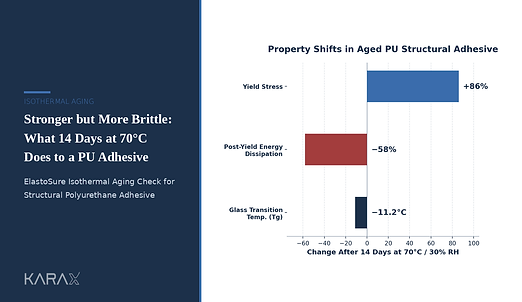
Stronger but More Brittle: What 14 Days at 70°C Really Does to a PU Adhesive
August 14, 2026
A structural polyurethane adhesive that looks stronger after two weeks of aging is quietly losing most of its ability to absorb energy before failure. Independent testing showed yield stress climbing 86% while post-yield energy dissipation dropped 58% and glass transition temperature fell over 11°C, a shift a strength-only test would completely miss...

The Sharpest Ductility Loss in the Study: What Cycling Heat and Humidity Does to a PU Adhesive
August 14, 2026
When a structural polyurethane adhesive is cycled through alternating hot-dry and humid conditions per ISO 9142, fracture strain drops 42%, the steepest ductility loss of any aging pathway tested. Karax checked ElastoSure against this data and found both the model and a simple linear baseline overshot the actual result, a limitation the white paper reports directly...

Two Data Points, One Forecast: What Can HNBR Aging Data Really Predict?
August 25, 2026
Karax fit a three-term Yeoh model to published HNBR curves before and after 72 hours at 175°C and 70 MPa in oil-based mud, reaching an R² of 0.9986. But the real question wasn't the fit, it was how far two experimental states can responsibly be projected. The forecast: 482 cycles to the study's crack endpoint at 360 hours, with Karax stating plainly that these are guidance values, not qualified service-life limits...

PBT Loses Nearly 40% of Its Strength After 2,000 Hours in Natural Ester Fluid
October 01, 2026
Karax traced PBT 30% glass-filled tensile strength from 17,673 psi to 10,660 psi over 2,000 hours of immersion in FR3 ester fluid at 170°C, a drop of nearly 40%. But the real question wasn't the decline itself, it was how far a two-point curve could responsibly be projected. The forecast: strength falling to roughly 4,994 psi by 5,000 hours, with Karax stating plainly that figures beyond the training window are...

PPA Held Its Strength in FR3, But the Fluid Itself Told a Different Story
October 01, 2026
Cargill TR-610 reports PPA with 35% glass fiber essentially holding its tensile strength through 2,000 hours at 170°C in FR3, rising slightly from 29,041 psi to 29,390 psi, with a two-point model projecting a continued gentle climb to 29,921 psi at 5,000 hours. But mechanical retention alone doesn't tell the whole story: a separate test on the FR3 fluid aged alongside the PPA measured a dielectric breakdown of 65 kV, compared to 74 kV for aged fluid without the polymer in it, a property of the fluid itself, not the polymer...

LCP Gained Tensile Strength in FR3, But Its Dielectric Rating Told a Different Story
October 01, 2026
Cargill TR-610 reports LCP with 30% glass fiber rising from 8,732 psi to 11,400 psi after 1,000 hours in 170°C FR3, with a two-point model fitting both values exactly and projecting an unvalidated extrapolation to 33,118 psi by 5,000 hours. But tensile strength is only half the qualification: the same material's solid dielectric strength measured above 50 kV before aging and just 35.2 kV after, a retention of less than...