.png)
LCP in FR3: Sample Tensile Forecast and Measured Electrical Loss
More tensile strength did not establish preserved solid dielectric behavior.

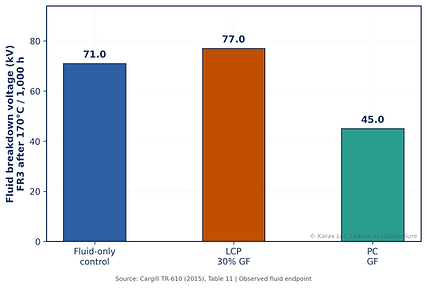
The problem addressed here is that an insulating component needs both mechanical and electrical qualification. Cargill TR-610 reports LCP with 30% glass fiber at an initial tensile strength of 8,732 psi, rising to 11,400 psi at 1,000 hours in 170°C FR3, and a two-point proxy model fits both measured values exactly, yielding illustrative projections of 12,186 psi at 1,250 hours and 33,118 psi at 5,000 hours. That latter figure is an unvalidated mathematical extrapolation, not a measured strength or a usable design value, and the ±20% rate limits shown are illustrative scenarios rather than genuine prediction intervals. Separately, the measured electrical data shows a sharper contrast: the solid dielectric declined from above 50 kV to 35.2 kV, a retention of less than 70.4%, while the fluid aged with LCP measured 77 kV compared to 71 kV for the aged fluid-only control, though this is a different object entirely from the solid insulation.
There is no held-out validation for either the mechanical or electrical results, and the sample curve shown is not ElastoSure software output. Cargill FR3 is the actual fluid tested in this report, while Celanese LCP grades are used only as category examples rather than the identified test specimens. The source is Cargill's 2015 technical report, Table 11, which is non-peer-reviewed.

Prediction Accuracy
95%
For long-term durability prediction
Experimental Tests
80,000+
Used for training and validation
vs. 6 Months
35 Days
Replacing long-weathering tests
Faster Analysis
5–10×
Compared to traditional FE models