.png)
ElastoSure models polymer aging in EV batteries and energy storage systems under real-world thermal and environmental conditions, helping predict material degradation, thermal runaway propagation, and remaining useful life.

Trusted by Industry, Government & Research Leaders


What Is Battery Insulation & Polymer Aging?
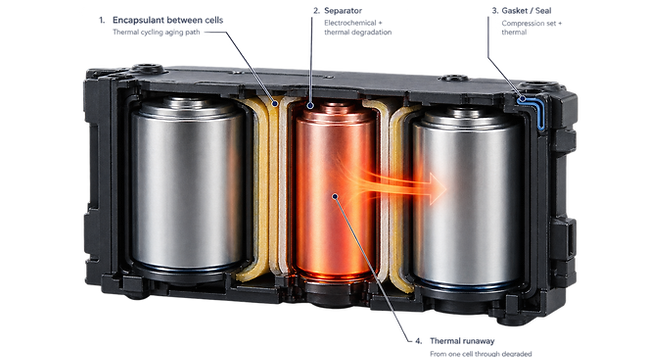
Polymers in battery systems provide critical functions including electrical insulation, thermal management, structural support, and sealing. Materials such as separators, encapsulants, potting compounds, and gaskets each face different degradation mechanisms.
Thermal runaway is the catastrophic failure mode: one cell overheats and heats the encapsulant. If degraded, the encapsulant loses its ability to absorb and contain heat, increasing the risk of cascading cell failures. The onset temperature and propagation rate depend critically on the encapsulant’s polymer chemistry and degradation state.
Battery cycling creates a unique multi-stressor aging environment: temperature swings from ambient to 60°C+ per cycle, sustained high temperatures during fast-charging, localized hotspots at defective cells, moisture ingress at pack seams, and mechanical fatigue from cell expansion and contraction (“breathing”). Together, these mechanisms can degrade polymer properties 3–5× faster than single-stressor test predictions.
What You Get From ElastoSure
Output
Encapsulant Damage Index
What It Tells You
Cumulative degradation state of the polymer encapsulant under real charge/discharge thermal history
Decision Enabled
Predict when encapsulant will fail to contain thermal runaway before the battery does in the field
Thermal runaway onset threshold
Minimum trigger energy needed to initiate cell-to-cell thermal runaway propagation through encapsulant
Design encapsulant thickness and material to guarantee containment for required number of years
Propagation velocity (K-Flash)
How fast a thermal runaway front moves through the encapsulant given its current degradation state
Specify vent design, fire suppression timing, and safe shutdown requirements for BMS
Gasket/seal compression set RUL
Time before battery pack seals lose sufficient seating force to prevent moisture ingress
Set resealing intervals and specify gasket material for target service life
Real-time aging update (K-Sense)
Current encapsulant Damage Index updated from actual BMS thermal log
Flag individual battery packs approaching thermal runaway risk before they reach it
Who Uses This

EV & Automotive
Battery aging and thermal runaway protection for EV platforms.
Explore Automotive
→

Aerospace
Battery reliability under extreme temperatures and demanding flight conditions.
Explore Aerospace
→

Grid Storage
Long-term battery performance for stationary energy storage systems.
Explore Grid Storage
→
ElastoSure in Action
Case Study

Thermal Cycling Aging
Humidity aging & long-term strength retention K-Load lap shear strength retention at 85% RH over 5 years.
View Case Study →

Thermal Runaway Propagation
How encapsulant aging affects heat propagation between cells.
View Case Study →