.png)
K-Extreme predicts polymer survivability under extreme HPHT conditions, while K-Load models long-term seal life under combined HPHT, fatigue, and fluid exposure—replacing months of physical testing with simulation.

Trusted by Industry, Government & Research Leaders


What Is HPHT Polymer & Elastomer Survivability?
Composite aging begins at the microstructural scale. The polymer matrix degrades, the fiber-matrix interface weakens, and damage accumulates across the laminate through micro-cracks and delamination.
Traditional fatigue tests provide design allowables, but not how those values change over years of moisture, thermal cycling, and real-world loading. ElastoSure models that degradation over the structure’s service life.
Moisture is a major driver. Water plasticizes the resin, lowers glass transition temperature (Tg), and weakens the fiber-matrix interface. Combined with thermal cycling and fatigue, these effects become synergistic—not simply additive.
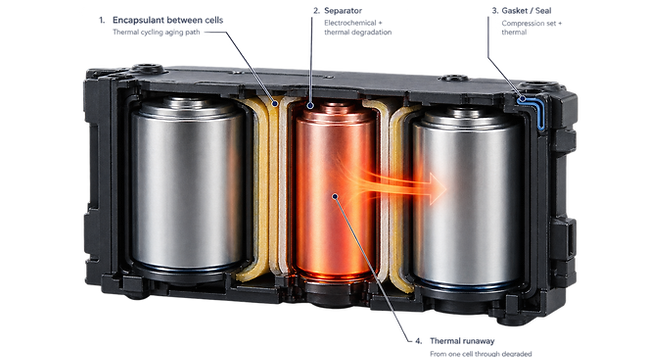
What You Get From ElastoSure for Composite & Fiber-Reinforced Polymer Aging
Output
Survivability Index
(K-Extreme)
What It Tells You
Probability the seal remains within specification after HPHT exposure -- with confidence interval
Decision Enabled
Replace physical qualification with quantified probability. Qualify seals in 35 days vs. 6 months.
DLO gradient through seal
Oxidation state and property loss from surface to core of the seal cross-section
Explains why thick seals fail faster than thin test coupons at the same HPHT condition
Fluid infiltration effect
Property change from oil, H2S, CO2, or brine exposure coupled with thermal degradation
Predict seal behavior in actual well fluid chemistry, not distilled water
Compression set progression
Sealing force loss as a function of HPHT exposure time and compressive strain
Predict when the seal loses contact force with the wellbore -- before the well leaks
Damage Index
(K-Load)
Cumulative life consumed across all HPHT damage modes at any time point
Know exactly where the seal is in its lifecycle for any well condition
Who Uses This

Aerospace
High-temperature engine seals, hydraulic elastomers, and extreme-environment O-rings.
Explore Aerospace
→

Oil & Gas
Downhole packer seals, wellbore liners, and completion equipment. CNPC field-trial validated.
Explore Oil & Gas
→

Geothermal
Well elastomers at 200–300°C, with survivability prediction for steam-exposed seals.
Explore Geothermal
→
ElastoSure in Action
Case Study

CFRP Moisture Aging
Moisture absorption and Tg degradation prediction with coupon test validation.
View Case Study →

Wind Turbine Blade Aging
20-year prediction of fatigue damage and UV surface oxidation.
View Case Study →