.png)

K-Load: Predict Component Life Under Real-World Combined Loading.
Your polymer is being attacked by multiple damage modes at once. Your tools were each built for one.
Fatigue in Abaqus. Hydrolysis in a spreadsheet. Thermal aging with Arrhenius. Radiation dose in a separate code. Then an engineer combines the results by hand and calls it a prediction. Every single-stressor tool you use today was built assuming all other damage modes are zero. They are not.
Single-stressor models underpredict real-world degradation by 30-60%. That gap is where your components fail early, your qualification margins are wrong, and your redesign cycles start.
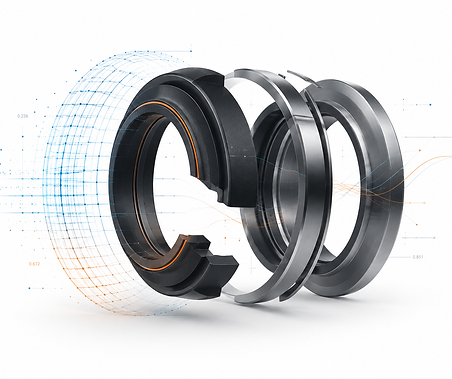
K-Load is the multi-damage-mode durability module inside ElastoSure by Karax -- predictive software for polymer, rubber, and elastomer aging, degradation, shelf life, service life, fatigue, durability, and reliability. The output is the Damage Index™ -- a single number showing how much life your component has consumed, and how much remains.
Trusted by Industry, Government & Research Leaders




What Is the Damage Index™?
What Is the Damage Index™?
The Damage Index™ is K-Load's unified output: a single value (0-100%) representing the cumulative damage consumed across all active damage modes simultaneously. It tells you how much of the component design life has been used, and how much remains - accounting for synergistic interaction between fatigue, temperature, humidity, oxidation, and radiation.
No other simulation tool outputs a unified multi-mode damage metric. Competitors give you one number per damage mode and leave the engineering judgment of combining them to the user. K-Load combines them in the physics model, where the interactions actually happen.

37%
Life Remaining


Every Damage Mode. One Model. One Damage Index™.
K-Load combines multiple damage modes into one physics-based model, capturing how they interact to consume component life.
Mechanical Damage
Fatigue • Viscoelasticity • Vibration
Physics-based fatigue life prediction under cyclic loading, accounting for stress relaxation, creep, and amplitude-dependent material behavior. Ghaderi et al. 2022/2023 fatigue model validated.
Damage Index™ contribution:
fatigue fraction + S-N curve + hysteresis energy map
HT-HP Damage
Thermal Oxidation • Inert Thermal • DLO (Diffusion Limited Oxidation)
High-temperature oxidation modeling, including DLO, where oxygen diffusion creates non-uniform oxidation through thick rubber cross sections. Validated by Ghaderi et al. 2026 (FEPM in HPHT).
Damage Index™ contribution:
oxidation fraction + DLO depth profile + stiffness vs. temperature map
Environmental Damage
Hydrolysis • Moisture Absorption
Models water-driven chain scission in polyurethanes, nylons, and adhesives. Tracks moisture ingress and property change as a function of exposure time, temperature, and relative humidity.
Damage Index™ contribution:
hydrolysis fraction + moisture profile + property retention curve
Radiation Damage
UV / Vacuum • Gamma • X-ray • Proton • Electron • Atomic Oxygen
Multi-radiation-type degradation models for space, nuclear, and sterilization environments. Synergistic interaction with thermal oxidation is captured. Validated: DOD Space Force.
Damage Index™ contribution:
radiation fraction + chain scission rate + dose-to-failure curve
Transient Damage
Thermal Cycling • Moisture Cycling • Corrosive Media • Infiltration
Thermal cycling fatigue, freeze-thaw degradation, and chemical media attack. Cyclic transient damage is multiplicatively coupled with mechanical and environmental modes in the K-Load damage model.
Damage Index™ contribution:
transient fraction + cycle count to failure + corrosion depth profile
Accidental Damage
Design Defects • Manufacturing Defects • Quality Issues • Black-Swan
K-Load integrates with third-party AD tools (ANSYS, Abaqus, NDT systems) for accidental and manufacturing defect inputs, using defect states as initial conditions for damage propagation.
Integration input:
defect size, location, severity fed into K-Load initial damage state then Damage
K-Load in Action: Three Material Classes, Three Damage Scenarios
K-Load combines multiple damage modes into one physics-based model, capturing how they interact to consume component life.
What K-Load Replaces. What You Get Instead.
What K-Load Simulates
Simultaneous multi-damage-mode simulation: fatigue + thermal + moisture + radiation + HT-HP in one physics model
DLO (Diffusion Limited Oxidation) for thick rubber cross-sections spatial oxidation gradient through the part
Viscoelastic and viscoplastic mechanical response under fatigue and vibration
Synergistic radiation + thermal oxidation degradation (combined stressor model, not additive)
Third-party AD integration: accepts defect state from Abaqus, NDT, or quality systems as initial condition
What You Eliminate
Manual aggregation of 5 separate tool outputs which misses damage mode interactions by design
Homogeneous Arrhenius model that assumes uniform aging (wrong for parts over 5mm thick)
Purely elastic FEA models that underestimate hysteresis heating and creep-driven failure
Separate radiation and thermal aging tests summed linearly -- which underpredicts combined degradation by 30-60%
Third-party AD integration: accepts defect state from Abaqus, NDT, or quality systems as initial condition
What You Get
Damage Index™: one unified metric combining all active damage modes with interaction terms
Accurate property gradient through cross-section no more over-testing thin samples and extrapolating
True fatigue life prediction including self-heating, stress relaxation, and amplitude dependence
Accurate combined stressor prediction: validated by DOD Space Force on space-grade elastomers
Full damage path from initial defect through in-service degradation to failure -- one coherent model
Multi-Damage-Mode Simulation, Proven Across Material Classes
Accuracy
95%
CNPC HPHT validated
Tests
80,000+
Multi-mode lab data
Damage modes
6
In one unified model
Material classes
3
NR, NBR, Silicone/SBR
Peer-Reviewed Research Behind K-Load
The science powering K-Load is supported by peer-reviewed publications in polymer aging, fatigue, and damage mechanics.
Considering low computational cost and short development cycle of our Physics-based AI-driven engines, they provide a powerful alternative for processing of existing data with significant cost advantage in analysis, design and optimization of the polymer materials.
Applications

Resins & Composites
Engine helps engineers select and maintain composite materials by predicting long-term polymer degradation. Supports epoxy, polyurethane, cyanate ester, and carbon-carbon composites while modeling pyrolysis, ablation, and irradiation for demanding environments.

Adhesives & Thermal Pastes
Accelerates formulation development by predicting material performance in harsh operating conditions. Optimizes products for extreme vibration, intense heat, extreme cold, ionizing radiation, and hot, humid environments.

Elastomers
Helps optimize gaskets, seals, and O-rings for high-pressure, high-temperature, corrosive, and radiation environments. Evaluates long-term durability and corrosion resistance of fluorinated elastomers.